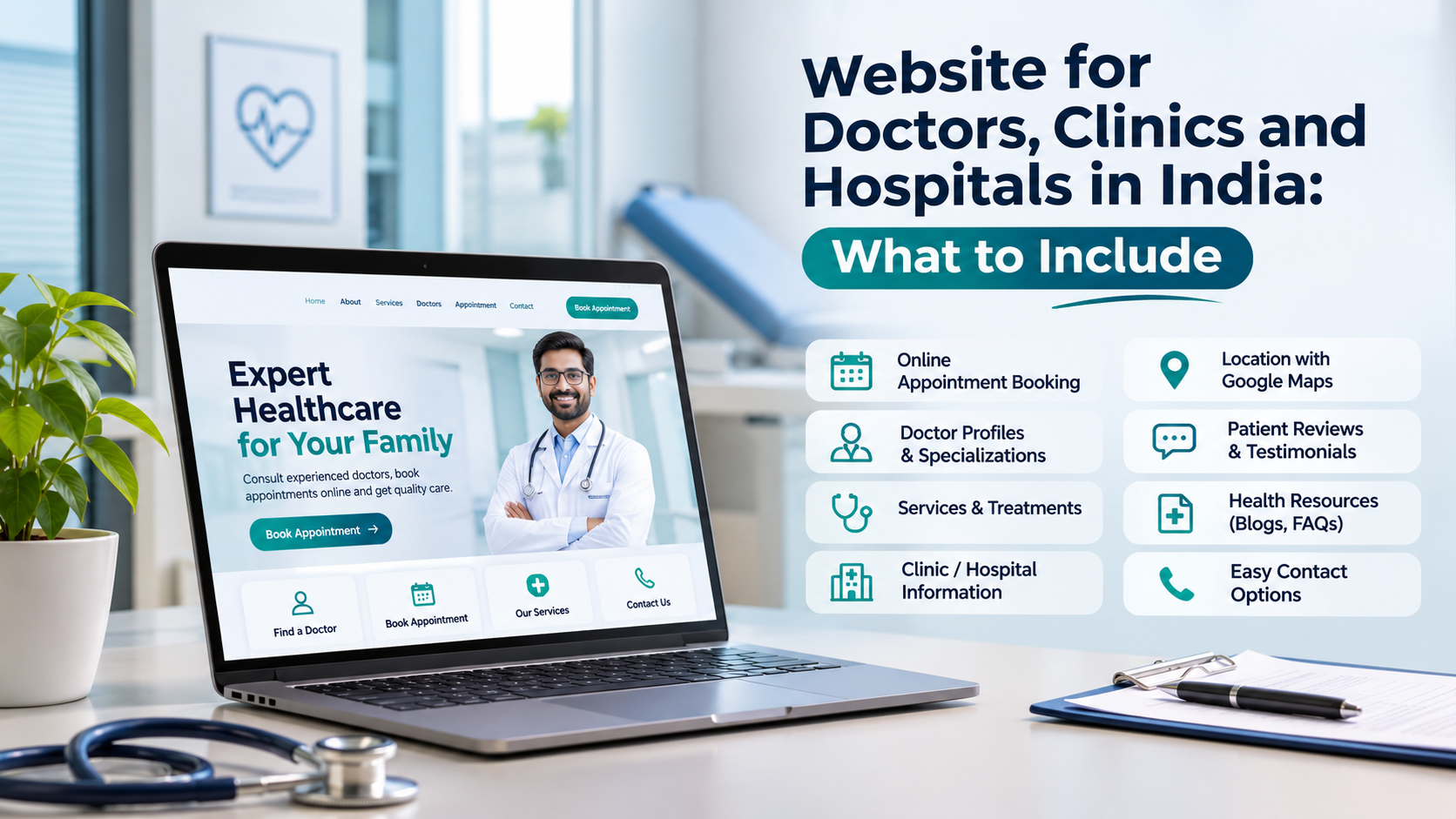
Website for Doctors, Clinics and Hospitals in India: What to Include
A simple guide to building a website for doctors, clinics, and hospitals in India. Learn what pages to include, how small clinics and large hospitals differ, how to build trust, and what the new NMC advertising guidelines mean for your content.
If your clinic or hospital has no website, or a poor one, you are not even in that conversation.
This guide is for single-doctor clinics, small nursing homes, and large multi-speciality hospitals. It covers what a good healthcare website needs, how a small clinic’s site differs from a hospital’s, and what the NMC’s new advertising rules mean for what you can put online.
Why Doctors and Hospitals Need a Website
Patients use the internet to answer simple questions: Who treats this problem? Where are they? Are they qualified? How do I reach them? A website answers all of that in one place and builds trust before the first visit.
A good site also helps in practical ways. Patients find your timings and location easily, your front desk answers fewer repeated questions, and your clinic looks credible to people who have never visited.
First, Understand the New NMC Rules
Before building anything, you should know the rules, because they affect what content is allowed. On October 6, 2026, the NMC’s Ethics and Medical Registration Board issued Guidelines on Ethical Advertising and Public Communication for registered medical practitioners, hospitals, and medical institutions, effective immediately. storyboard18
In plain language, the guidelines separate factual information, which is allowed, from promotional claims, which are restricted. Reports on the guidelines say they:
Restrict promotional claims such as “No.1,” “best doctor,” and “100% success.” storyboard18
Bar fake, paid, or misleading patient reviews, ratings, and testimonials, and say a doctor shall not request or share patient testimonials or reviews for professional promotion on social media. researchgate
Say agencies cannot be engaged on terms where payment is tied to patient referrals. bestmediainfo
Allow hospital websites to keep doctor directories with details like name, recognised qualifications, specialty, registration details, and availability, when the purpose is patient information rather than paid or promotional visibility. storyboard18
There are also reports that the rules treat hospitals and individual doctors differently, and that interpretations differ on things like asking patients for Google reviews. One analysis says even asking a satisfied patient for a review for promotional purposes is now covered, while another reading says clinic-led requests are fine if there are no incentives or gating. Because the guidelines are new, read the official notice on the NMC website and have your legal or compliance advisor review your site. This blog is general information, not legal advice. medhive
What a Good Doctor or Clinic Website Needs
For a small clinic or individual doctor, keep it simple and factual. You need:
A clear homepage. Say who you are, what you treat, and where you are, in plain words.
Doctor profile. Name, recognised qualifications, specialty, registration number, and experience, stated factually.
Services and conditions treated. Short, clear pages that explain what you do, written for patients and not full of jargon.
Clinic timings and location. With a map and directions.
A simple way to contact or book. A phone number, WhatsApp, or appointment form.
Health education. Short articles that explain conditions, preventive care, and what to expect during a visit.
FAQs. Answers to common questions, such as what to bring and how appointments work.
A privacy policy and clear contact details.
What a Hospital Website Needs
A hospital website is a bigger project, because it serves many patients and departments. On top of the basics, it usually needs:
Department and speciality pages, each with its own clear structure
A doctor directory with name, qualifications, specialty, registration details, and availability, as long as it is factual
Facilities and services, such as emergency care, diagnostics, pharmacy, and ambulance
Appointment and enquiry forms that route to the right department
Patient information, including visiting hours, admission process, insurance and cashless details
Location pages for each branch, with directions
News and awareness content, kept educational
Strong security and privacy, because forms collect personal data
Small Clinic vs Hospital: What Differs
Small clinic or single doctor | Large hospital | |
|---|---|---|
Number of pages | 5 to 12 | Often dozens or more |
Main goal | Be found nearby, build trust, get appointment calls | Help patients find the right department and doctor |
Content | Doctor profile, services, FAQs | Departments, doctor directory, facilities, branches |
Tools | Call, WhatsApp, simple form | Appointment systems, department routing, patient portals |
Risk areas | Claims and testimonials | Same, plus data privacy and scale |
Both need to be fast, mobile-friendly, and easy to understand. The size of the project is different, but the principles are the same.
Trust Matters More Than Design
Medical websites are about trust. A few things build it:
Real, recognisable photos of the clinic and team, used to help patients recognise the place and not to promote
Credentials stated clearly and accurately
Simple, honest language with no exaggerated claims
Clear contact details and an address that matches Google Maps
Regularly updated content
And a few things damage it, and may also break the rules:
Words like “best,” “No.1,” “leading,” or “guaranteed cure”
Before-and-after photos and patient success stories used for promotion
Testimonials and review widgets that promote your practice
Pop-ups offering discounts or “free consultation” gimmicks
Fake or purchased reviews, which are barred
Make It Easy to Find
Even the best website needs to be found. Focus on these basics:
A complete Google Business Profile with the correct name, address, phone number, timings, and specialties.
Clear service pages that match what patients search, such as “knee pain treatment in Lucknow” or “paediatrician near me.”
A fast, mobile-friendly site, since most patients search on their phones.
Consistent details across your website, Google profile, and directories.
Educational articles that answer real patient questions.
If you want help here, you can see how GlanceTechy’s SEO services help local businesses get found on Google.
Privacy and Security
Healthcare sites often collect names, phone numbers, and health concerns through forms. So you should:
Use HTTPS and secure hosting
Collect only the information you really need
Add a clear privacy policy and consent text on forms
Control who has access to submissions
Keep software updated and take regular backups
If you handle sensitive patient data, ask your legal advisor about the privacy requirements that apply to you.
Choosing a Web Partner for a Medical Website
Not every web agency understands healthcare rules. Ask:
Have you built websites for doctors, clinics, or hospitals?
How will you make sure content follows the NMC guidelines?
Who approves content, and how are changes handled?
Is your pricing fixed? Be careful with any agency that charges per patient or per lead, because the guidelines do not allow payment tied to patient referrals.
How will you handle security and privacy?
What support is available after launch?
Do I own my website, domain, and content?
How GlanceTechy Helps
We build websites for doctors, clinics, and hospitals, from a single-doctor practice to larger multi-department institutions. Our approach is simple: fast, mobile-friendly sites with clear structure, factual content, and easy ways for patients to reach you. Our plans are fixed monthly plans and are not tied to patient numbers.
You can see our website design and development services, the portfolio for examples of our work, or the pricing page. We can also design the layout first with Figma UI/UX design, so you can review it before we build. To discuss your project, contact us for a free call.
Final Thoughts
A good medical website is clear, factual, and trustworthy. For a small clinic, that means a simple, fast site with your credentials and contact details. For a hospital, it means well-organised departments, a factual doctor directory, and strong privacy. In both cases, it needs to follow the advertising rules, which are now stricter.
Start with the basics: clear information, easy contact, and honest content. Then keep it updated, and let patients find you.
Frequently asked questions
It is not required, but it helps patients find you, check your qualifications, and contact you. A simple, factual website builds trust before the first visit.
A clear homepage, a factual doctor profile with qualifications and registration details, services, clinic timings and location, an easy way to contact or book, and educational content.
Reports on the NMC guidelines say hospital websites can keep factual doctor directories with details like name, qualifications, specialty, registration, and availability, when the purpose is patient information. Check the official notice and your advisor.
The new guidelines restrict patient testimonials and reviews used for promotion, so this is risky. Get advice from a legal or compliance professional before publishing anything like this.
No. The guidelines restrict claims like these, and you should stick to factual, verifiable information.
It depends on the size, number of pages, features, and integrations. A small clinic site is much simpler than a multi-department hospital portal. You can see our pricing page, or contact us for a quote.