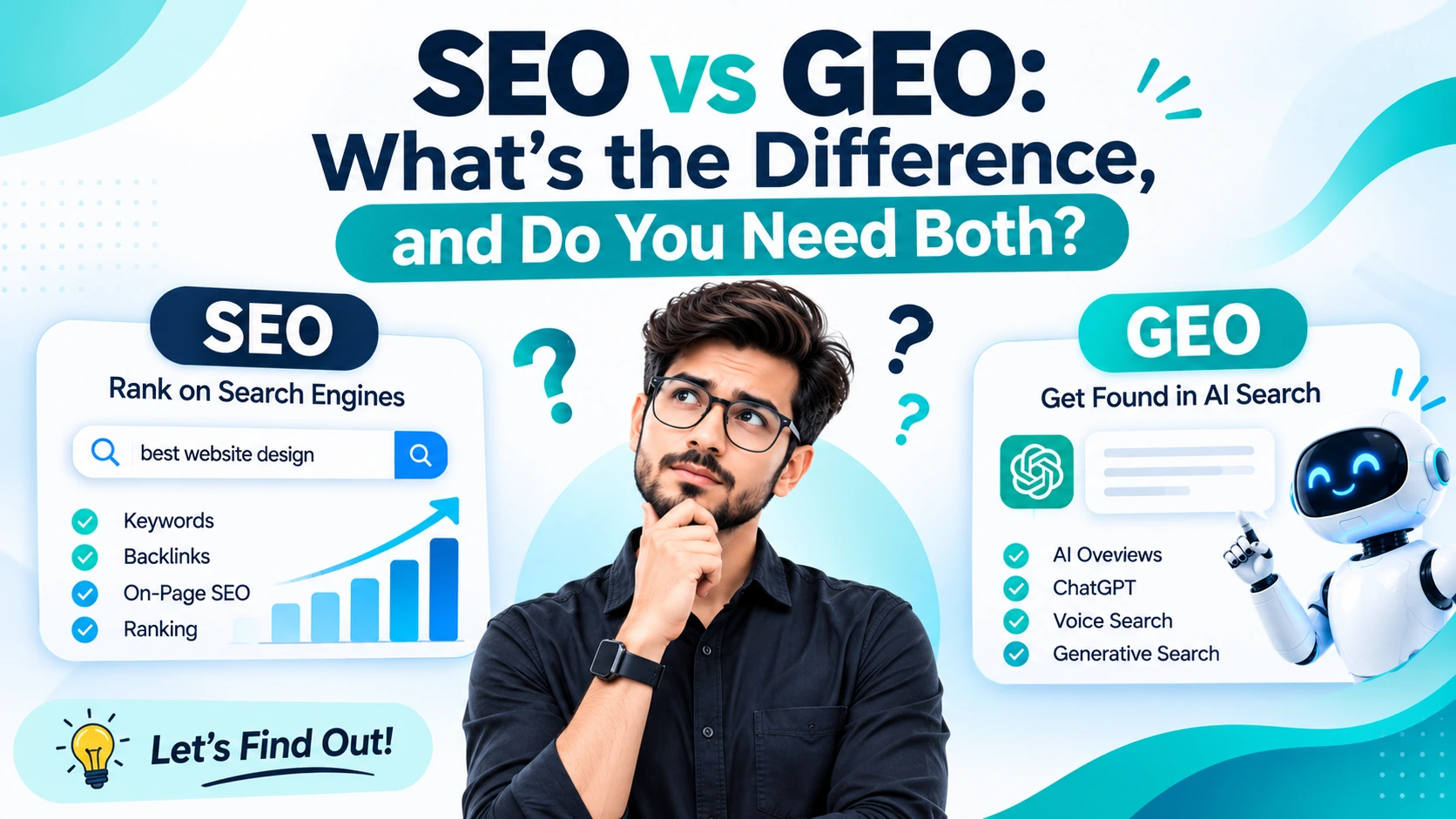
SEO vs GEO: What’s the Difference, and Do You Need Both?
SEO helps you rank in search. GEO helps AI tools mention your business. Learn how they differ, what they have in common, and a simple 30-day plan for small businesses to get found in both Google and AI answers.
It’s a fair question. People are asking ChatGPT, Gemini, and other AI tools for recommendations, and some of them never click through to a website at all. So it’s natural to wonder whether the old rules still apply.
Here’s the short version: you don’t have to choose. SEO and GEO are closely related, and the work you do for one helps the other. This guide explains the difference in plain language and shows you where to put your time.
What Is SEO?
SEO (Search Engine Optimization) is the work of helping your website show up in search results like Google and Bing. When someone searches “dentist in Lucknow,” SEO is a big part of why one clinic appears above another.
Good SEO usually covers:
Technical health: a fast, mobile-friendly site that search engines can read
Content: pages and articles that answer what people are searching for
Authority: links and mentions from other trusted websites
Local signals: a complete Google Business Profile, reviews, and consistent business details
The goal is simple. Get found, get clicked, get enquiries.
What Is GEO?
GEO (Generative Engine Optimization) is the work of helping AI tools understand your business and mention it in their answers. Think ChatGPT, Gemini, Perplexity, and the AI summaries that now show up in search results.
Instead of a list of links, an AI tool gives one direct answer, built from a few sources. So the goal shifts from “rank on page one” to “be one of the sources the AI trusts and includes.”
You will also see this called AI search optimization, AI visibility, or answer engine optimization. The names differ, but the idea is the same.
SEO vs GEO: The Key Differences
SEO | GEO | |
|---|---|---|
Main goal | Rank in search results | Be mentioned in AI answers |
What success looks like | Clicks and traffic | Mentions, citations, and accurate descriptions |
Where it works | Google, Bing | ChatGPT, Gemini, Perplexity, AI summaries |
What matters most | Keywords, links, technical health | Clear content, trust, consistent information |
How you measure it | Rankings, traffic, leads | Testing prompts, checking mentions and accuracy |
One honest note. GEO is newer, and nobody outside the AI companies fully knows how every answer is put together. So be careful with anyone who promises guaranteed results.
What They Have in Common
This is the part many people miss. SEO and GEO share most of their foundation:
Helpful, honest content. Pages that clearly answer real questions do well in both.
Clear structure. Descriptive headings, short paragraphs, and simple explanations are easier for search engines and AI tools to understand.
Trust signals. Reviews, mentions, and real experience matter in both places.
A healthy website. Slow, broken, or confusing sites hurt you everywhere.
That’s why strong SEO is not wasted effort. It’s the base GEO is built on.
Where They Differ in Practice
A few things get extra attention when you think about GEO.
1. Say it plainly. A line like “Innovative solutions for modern businesses” tells an AI tool nothing. “Web design and SEO for small businesses in Lucknow” tells it exactly who you help and where.
2. Answer questions directly. Short, honest answers near the top of a page, plus a useful FAQ, are easy for AI to pick up. They also help real visitors.
3. Be consistent everywhere. Your name, services, address, and phone number should match across your website, Google Business Profile, and directories. Mixed-up details can lead to wrong or missing mentions.
4. Build mentions beyond your own site. Reviews, directory listings, and coverage on trusted sites add to your credibility.
5. Check what AI actually says about you. Unlike rankings, you can test this yourself in minutes. We’ll do that below.
Do You Need Both?
For most small and mid-sized businesses, yes, but in a sensible order.
If your SEO basics are weak (slow site, thin pages, incomplete Google Business Profile), fix those first. They help you in search and in AI.
If your SEO is decent and competitors are being mentioned by AI tools while you’re not, add GEO work on top.
If you are a local business, local SEO and reviews matter most, and they also feed GEO.
If you are B2B or in a trust-heavy field (finance, health, education), clear expertise and consistent information are especially important.
Think of GEO as another layer on your marketing, not a new job that replaces the old one.
A Quick Test You Can Do Today
You can learn more from this than from most reports:
Open two or three AI tools.
Ask the questions your customers would ask, like “best [your service] in [your city]” or “how do I choose a [your service]?”
Note whether you’re mentioned, and what is said about you.
Note who is mentioned, and look at how their websites explain what they do.
Check whether the details about you are correct.
Then write down the three easiest fixes and do them this week.
Common Myths
“SEO is dead.” No. People still search every day, and AI tools often draw on the same kind of content that good SEO produces.
“GEO is just SEO with a new name.” Partly true, but not completely. The foundation overlaps, yet the goals, the way you test results, and some of the content habits differ.
“I can trick AI into recommending me.” Shortcuts tend to stop working quickly, and they can hurt your reputation. Real clarity and trust last longer.
“AI content will do the job for me.” Mass-produced, generic pages don’t build trust with people or with search. Your real experience is what stands out.
A Simple Plan for the Next 30 Days
Week 1: Run the AI test, and fix your Google Business Profile.
Week 2: Rewrite your homepage headline so it clearly says what you do and where.
Week 3: Add a short FAQ to your main service page, and make your business details match everywhere.
Week 4: Ask your happy customers for reviews, and publish one genuinely useful article.
Small, steady steps beat a big one-time push.
Getting Help
If you would rather have a team handle the technical side, you can see how GlanceTechy’s SEO services help businesses get found on Google. If you want to check and improve how your business appears in AI answers, take a look at our GEO and AI search optimization services.
Final Thoughts
SEO vs GEO is less of a battle than it sounds. SEO helps people find you in search. GEO helps AI tools understand and mention you. Both reward the same things: clear information, real expertise, and a website people can trust.
Start with the basics, test how AI describes your business, and fix the gaps one by one. The businesses that do this steadily will be easy to find wherever their customers choose to look.
FAQ
Frequently asked questions
SEO helps your website rank in search results like Google. GEO helps AI tools like ChatGPT and Gemini understand your business and mention it in their answers. SEO aims for clicks and rankings, while GEO aims for accurate mentions inside AI-generated answers.
No. People still search on Google every day, and AI tools often draw on the same kind of clear, trustworthy content that good SEO produces. GEO is best seen as an extra layer on top of SEO, not a replacement.
Most can benefit, especially if customers research online before buying. But start with the basics first: a clear website, a complete Google Business Profile, and real reviews. These help in both search and AI answers.
Ask two or three AI tools the questions your customers would ask, such as “best web designers in Lucknow.” Note whether you’re mentioned, what is said about you, and whether the details are correct. It takes about 15 minutes.
No. Nobody outside these companies controls their answers. Be careful with anyone who promises a guaranteed spot. What you can do is make your business clear, consistent, and trustworthy, which improves your chances.
There is no fixed timeline. Small fixes, like correcting inconsistent business details or improving page clarity, can help within weeks. Building reviews and authority usually takes a few months, and AI tools change often, so treat it as ongoing work.
Fix your SEO basics first: a fast, mobile-friendly website, clear service pages, and a complete Google Business Profile. Once those are in place, add GEO steps like a clear homepage message, an FAQ, and consistent details across the web.
Not on its own. Mass-produced, generic pages don’t build trust with people or search engines. Content that shares real experience, honest answers, and specific details is far more likely to stand out.