How to Make Your Website Visible in AI Search (ChatGPT, Gemini and Perplexity)
Learn how to make your website visible in AI search. Cover the basics of SEO, AEO, and GEO, crawler access, structured data, brand authority, and how to check what ChatGPT, Gemini, and Perplexity say about your business.

If yours isn’t one of them, that customer may never know you exist. They didn’t visit a competitor’s website and compare. They just got an answer.
This is why AI search optimization is getting so much attention. Search is no longer only a list of blue links. Tools like ChatGPT, Google Gemini, and Perplexity give direct answers, and they pull from websites, directories, reviews, and other sources to do it.
There is no trick that guarantees a mention. But there are practical, honest steps that make your website easier to find and easier to trust. Here is what to focus on.
First, Know the Three Terms
You will hear these three terms a lot, and they overlap more than people admit.
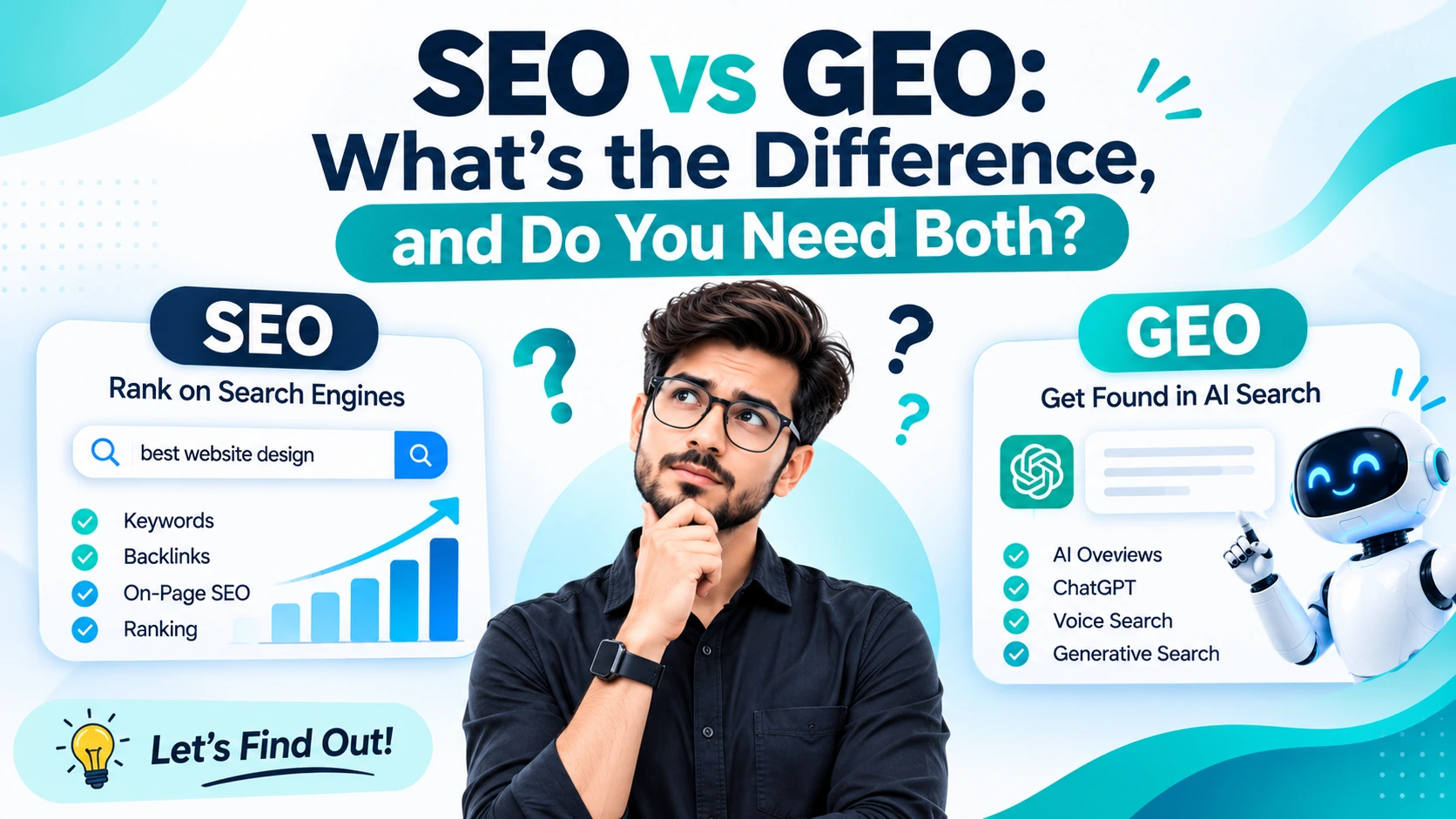
SEO (Search Engine Optimization): helping your website show up in search results like Google and Bing.
AEO (Answer Engine Optimization): writing content that answers questions clearly and directly.
GEO (Generative Engine Optimization): helping AI tools discover, understand, and mention your brand in generated answers.
Think of them as layers. Strong SEO is the base, clear answers are the next layer, and GEO is the extra attention on how AI describes you. You don’t need three separate strategies, just one good one.
1. Answer the Questions Customers Actually Ask
The best way to be useful to AI (and to people) is to answer real questions properly. Before someone hires a web development company, they might ask:
How much does a business website cost?
Should I choose WordPress or custom development?
How long does a website take to build?
What should a professional business website include?
How do I choose the right web development company?
Don’t write a 300-word post stuffed with keywords. Write a proper guide. Answer the main question in the first few lines, explain it in simple language, give examples, and cover the follow-up questions people usually ask next.
A good test: would you be happy to hand this page to a customer sitting in front of you?
2. Make Sure Crawlers Can Reach Your Site
Excellent content can’t help you if search systems can’t access it. Check the technical basics first.
Review your robots.txt. Make sure you aren’t accidentally blocking legitimate crawlers. OpenAI, for example, uses a crawler called OAI-SearchBot for ChatGPT search, so if you want to be eligible there, your rules should not block it:
User-agent: OAI-SearchBot
Allow: /
This is only an example, not a complete robots.txt file, so review your existing rules before changing anything. Other platforms have their own crawlers, so check each platform’s documentation.
Submit your XML sitemap and make sure it lists your important service pages and blog posts.
Fix the common problems:
Accidental noindex tags
Wrong canonical URLs
Broken internal links
Redirect errors
Pages that load slowly or fail now and then
None of this is exciting, but it is the foundation everything else sits on.
3. Structure Your Pages Clearly
Make each page easy to read for a person and easy to understand for a machine.
Use meaningful H1, H2, and H3 headings, so each heading tells the reader what comes next.
Write clear page titles that describe the topic and include the main keyword naturally.
Answer directly. If your heading is “What is GEO?”, start the section with a plain explanation before going into details.
Add internal links between related blog posts and service pages.
Include a short FAQ with questions customers genuinely ask.
If a page is hard to skim, it’s hard to understand for everyone.
4. Build Your Reputation Beyond Your Own Website
AI tools don’t rely only on what you say about yourself. They also see what others say, and where your brand shows up.
Practical steps:
Keep your Google Business Profile complete and updated.
Maintain an active LinkedIn company page.
Collect genuine reviews and testimonials.
Publish useful articles about your industry.
Get mentioned on trustworthy, relevant websites.
Keep your business name, website, and service descriptions consistent everywhere.
If you offer website design, development, SEO, and digital marketing, make sure those services are described the same way on your site and on your profiles. And avoid buying low-quality backlinks or creating fake references. It tends to backfire.
5. Use Structured Data (But Be Realistic)
Structured data (Schema.org markup) helps search systems understand specific facts about your website. Useful types include:
Organization: your company name, website, and contact details
LocalBusiness: business details for a local company
Article: headline, author, and publish details for blog posts
BreadcrumbList: the navigation structure of your site
FAQPage: questions and answers on a page
Make sure the markup matches what is actually visible on the page. And keep expectations realistic. Schema can help systems understand your site more clearly, but it does not guarantee that any AI platform will recommend you.
6. Publish Content From Real Experience
Thousands of websites publish the same generic article about SEO or web development. If yours says the same thing as everyone else, there’s little reason to cite it.
What sets you apart is real experience. If you’re writing about website speed, for example, share what actually slowed down a real project and how you fixed it: oversized images, unnecessary scripts, cheap hosting. Add case studies, practical tutorials, and lessons from mistakes.
That kind of detail is hard to copy, and it shows readers you’ve actually done the work.
7. Don’t Neglect the Website Experience
Being found is only half the job. Once visitors land, the site has to help them take the next step.
Responsive design for mobile, tablet, and desktop
Fast loading pages
Clear navigation
Readable text
Easy-to-find contact details
Clear service descriptions and calls to action
Secure HTTPS
Visibility and conversions are different goals, and you need both.
8. Keep Google and Bing in Your Toolkit
Traditional search tools still matter.
Google Search Console shows indexing status, search queries, impressions, clicks, and technical issues.
Bing Webmaster Tools is now worth setting up too. Microsoft released an AI Performance report in public preview in February 2026, which shows how often your pages are cited in Copilot and AI-generated answers in Bing. It currently covers Bing Copilot and AI summaries only, not other assistants such as ChatGPT. So it’s a useful signal, not a full picture. searchinfluenceadobe
You can also look at IndexNow, which helps notify participating search engines when your content changes. No single tool guarantees visibility across every AI platform.
9. Check How AI Describes You, Regularly
AI answers change depending on the question, location, context, and whether the tool is searching the live web. So treat this as an ongoing habit, not a one-time check.
Write down the questions your customers might ask. For a web development company, that could be:
Recommend a website design company in India.
Which companies offer custom website development?
What is the best web development agency for small businesses?
Which agencies offer SEO and AI search optimization?
Ask them in ChatGPT, Gemini, and Perplexity, then record:
Whether your brand appears
Whether the information about you is accurate
Which pages or sources are referenced
Which competitors are mentioned
Whether anything changes over time
Don’t rely on a single result. Repeat the checks every month or so, and look at your analytics to see whether visitors are arriving from AI tools.
Mistakes to Avoid
Publishing AI-generated content without review. AI can help you draft, but check it for accuracy and add your own experience.
Ignoring technical SEO. If pages can’t be crawled or indexed, more articles won’t fix it.
Keyword stuffing. It makes content hard to read and adds no value.
Buying irrelevant backlinks. A few relevant, trustworthy mentions beat hundreds of poor ones.
Expecting instant results. Nobody can guarantee that ChatGPT, Gemini, or Perplexity will recommend a specific business.
Inconsistent business information. Your website, profiles, and external listings should tell the same story.
Final Thoughts
Search habits are changing, and it makes sense to prepare. But you don’t need to rebuild everything overnight. Start with the basics: helpful content, a site that crawlers can reach, clear structure, and a reputation that is easy to verify. Then check how AI describes you, and improve step by step.
If you’d like help with this, GlanceTechy works on website design, development, SEO, and AI search visibility. You can see how our GEO and AI search optimization services work, or learn more about us at glancetechy.com.