US Midterm Elections 2026: What Do the Results Mean for India's IT Industry and Outsourcing?
Explore how the 2026 US midterm elections could impact India's IT industry, outsourcing, software development, AI services, and future business opportunities for Indian technology companies.
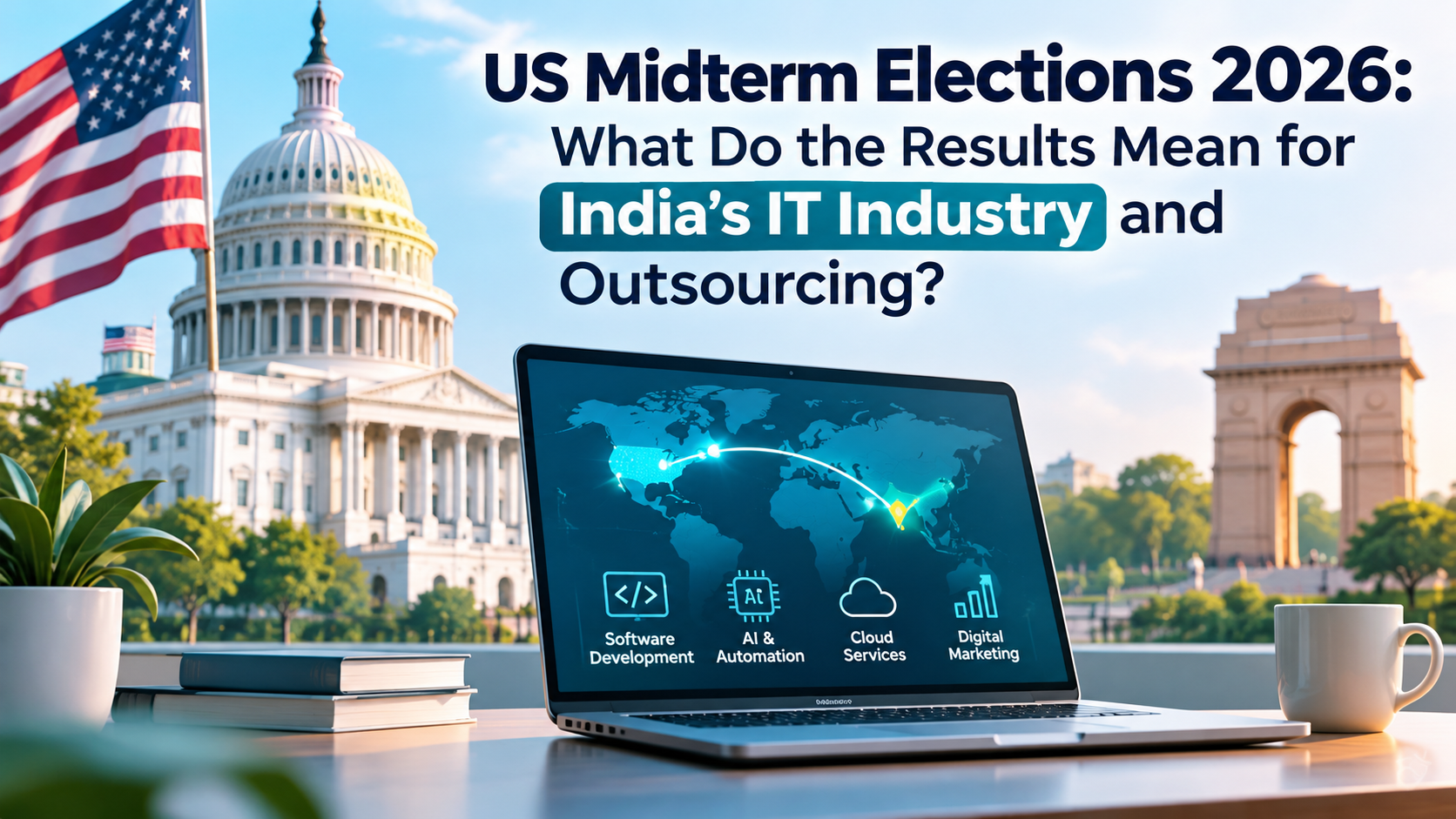
But beyond American politics, there's another important question:
What does this mean for India's IT industry, software development companies, and businesses that depend on US clients?
India has become a major technology partner for American businesses. From software development and website design to cloud computing, artificial intelligence, and IT consulting, thousands of Indian companies serve customers in the United States.
A change in US political leadership can influence business confidence, immigration policies, outsourcing regulations, and technology investment.
However, the election results do not automatically mean more outsourcing contracts or higher revenues for Indian IT companies.
Let's explore what has changed, what remains uncertain, and where new business opportunities could emerge.
What Happened in the 2026 US Midterm Elections?
The US held its midterm elections on November 3, 2026.
Unlike presidential elections, midterm elections determine representation in Congress and several state and local offices.
Democrats won control of the House of Representatives and Senate, creating a more challenging legislative environment for President Trump's administration.
Trump remains President of the United States. The election did not remove him from office.
The new congressional balance could affect how future legislation involving immigration, international trade, outsourcing, and technology policy is debated.
For Indian technology companies, the important question is not simply which political party won.
It is how future policies affect the cost and ease of doing business with American clients.
Why the US Market Matters So Much to India's IT Industry
The United States is one of India's largest markets for technology services.
Indian companies provide services including:
Custom software and web development
Cloud infrastructure and migration
Artificial intelligence and automation
Cybersecurity and IT consulting
Website design and UI/UX development
Data analytics and enterprise software
Business process outsourcing
According to figures reported from the Reserve Bank of India's September 2026 survey, US purchases of Indian software services reached approximately $119.7 billion in FY2025–26, compared with $108.3 billion the previous year.
This illustrates how closely India's technology sector is connected to American business spending.
When US companies invest more in technology, Indian service providers may benefit. When American businesses reduce spending or delay projects, Indian companies can feel the impact.
That connection makes US policy developments important for India's technology industry.
1. Could the Election Results Increase IT Outsourcing to India?
This is one of the biggest questions for Indian technology companies.
The short answer is that outsourcing opportunities could grow, but an immediate increase is not guaranteed.
American companies often work with Indian technology partners because they need specialized skills, flexible delivery teams, and cost-effective development.
These business needs do not disappear after an election.
However, political changes can influence whether companies expand international partnerships, hire more employees locally, or postpone technology investments.
For example, an American startup planning a new software product may choose an Indian development partner to manage costs.
A growing e-commerce business may outsource website development or maintenance.
A marketing agency may collaborate with an offshore team for design, SEO, and technical implementation.
These opportunities depend primarily on business requirements, project budgets, trust, and service quality.
The election could influence the broader environment, but it is unlikely to determine every outsourcing decision.
2. What Could Change for H-1B Visas and Indian IT Professionals?
Immigration policy remains an important issue for India's technology sector.
Indian IT companies use different delivery models. Some employees work remotely from India, while others work at client locations in the United States.
Restrictions on skilled-worker visas can increase uncertainty and make certain on-site delivery arrangements more difficult.
Following the midterm results, the new Congress may scrutinize some immigration measures more closely.
However, congressional control does not automatically reverse existing executive actions, agency regulations, or visa restrictions.
For Indian IT businesses, the practical response is to maintain flexible delivery models and avoid depending on a single immigration pathway.
Remote collaboration, distributed teams, and locally based client-facing partners may remain useful options.
3. Could New Outsourcing Taxes Affect Indian IT Companies?
One policy area worth watching is the treatment of payments made by American companies to overseas service providers.
US lawmakers have introduced proposals that could increase the cost of certain international outsourcing arrangements.
For example, the proposed HIRE Act included a 25% excise tax on specified outsourcing payments.
That proposal is not an enacted tax.
Its future depends on the legislative process, and it would not necessarily apply to every type of international technology contract.
Still, the debate matters.
If outsourcing becomes more expensive or administratively complicated, American companies may reconsider how they structure international projects.
Indian service providers should monitor these developments rather than assume that US outsourcing regulations will automatically become more favorable.
4. AI and Automation Could Create New Opportunities
Artificial intelligence is changing what businesses expect from technology partners.
Companies are no longer looking only for websites and basic software.
Many also want solutions that help their teams work faster, reduce repetitive tasks, and improve customer experiences.
This creates potential demand for:
AI-Powered Customer Support
Businesses may want chatbots and intelligent support systems that answer common questions, qualify enquiries, and connect customers with the right team.
Workflow Automation
Companies can automate repetitive activities such as lead routing, appointment notifications, reporting, and data entry.
AI Integration
Existing websites and business applications may need AI-powered search, content assistance, analytics, or productivity features.
Data and Reporting
Businesses increasingly need clear reporting that connects technology investments with measurable outcomes.
For Indian developers and agencies, these services offer opportunities to move beyond basic project delivery.
The challenge is to demonstrate genuine technical capability and business value rather than simply adding AI-related terms to service descriptions.
5. What About Website Design and Development Companies?
Smaller technology agencies may see different opportunities from large IT outsourcing companies.
A major enterprise might require a multi-year software modernization contract.
A small US business may need something more immediate:
A professional business website
An e-commerce store
A website redesign
Faster page loading
Better mobile usability
Online booking or enquiry forms
CRM and marketing integrations
These projects can often be delivered remotely.
That makes international collaboration practical for smaller agencies with strong portfolios, reliable communication, and clear project processes.
However, US clients are unlikely to choose an overseas partner based on price alone.
They also want confidence that projects will be delivered on time, that their data will be handled responsibly, and that the final product will meet their business needs.
6. SEO, Digital Marketing, and AI Search Services
Technology development is only one part of the opportunity.
American businesses also need customers.
A well-designed website has limited commercial value if potential customers cannot discover it or understand what to do next.
This creates ongoing demand for services such as:
Search Engine Optimization (SEO): Improving a website's visibility in relevant organic search results.
Local SEO: Helping businesses maintain accurate local listings and improve their visibility for location-based searches.
Google Ads and PPC: Reaching potential customers through paid advertising campaigns.
Conversion Rate Optimization: Improving landing pages, forms, messaging, and user journeys.
AI Search Optimization (AEO/GEO): Making website content clearer, more accessible, and useful for AI-powered discovery experiences.
These services may create opportunities for Indian agencies serving international markets.
But demand will still depend on client budgets, competitive conditions, and the agency's ability to demonstrate results.
7. Will Indian IT Companies Get More US Projects in 2027?
It is too early to provide a reliable percentage increase in projects directly attributable to the 2026 election.
The outcome depends on several factors:
Factor | Possible Effect |
|---|---|
US technology spending | Higher spending may create more projects |
Immigration policy | May influence on-site and offshore delivery models |
Outsourcing legislation | Could change the cost of international contracts |
AI adoption | May increase demand for integration and automation |
Economic uncertainty | May delay project approvals |
Competition | Could put pressure on pricing and margins |
Three broad scenarios are possible.
Growth Scenario
American businesses increase investment in software, cloud, AI, and digital transformation.
Indian providers with specialized skills and strong client relationships may win additional work.
Stable Scenario
Outsourcing continues at existing levels, with new contracts largely driven by normal business demand.
Challenging Scenario
Policy uncertainty, higher operating costs, or weaker client spending cause companies to delay or reduce some technology projects.
These are scenarios, not forecasts of a particular election outcome or guaranteed business growth.
8. How Indian IT Agencies Can Prepare for US Business Opportunities
Regardless of political developments, Indian technology companies can take practical steps to improve their competitiveness.
Build a Strong International Portfolio
US clients want to see relevant work, not just a long list of technologies.
Case studies should explain the problem, the solution, and any verified results.
Offer Specialized Services
A focused offer such as Next.js development, WordPress redesign, e-commerce optimization, or AI workflow integration may be easier to communicate than a generic promise to provide every technology service.
Improve Communication
Clear proposals, realistic timelines, regular updates, and reliable support help build long-term relationships.
Develop Agency Partnerships
US design studios, marketing agencies, and software consultancies may need reliable implementation partners.
White-label development and ongoing technical support can be useful partnership models.
Focus on Business Outcomes
Clients are usually more interested in what a solution accomplishes than which programming language was used.
Explain how the work improves usability, efficiency, visibility, or customer experience.
Stay Informed About Policy Changes
Review relevant outsourcing, privacy, tax, and immigration developments with qualified advisers when necessary.
Do not assume that proposed legislation has become law.
9. What This Means for GlanceTechy and Other Growing Digital Agencies
At GlanceTechy, we see international collaboration as an opportunity built around technology expertise, transparent communication, and practical business solutions.
Our services include:
Website Design & Development
React, Next.js, and WordPress Development
E-commerce Website Development
UI/UX and Figma Design
SEO, AEO, and GEO
Google Ads and Performance Marketing
AI Integration and Digital Solutions
For businesses in the United States and other international markets, working with an experienced remote technology partner can provide access to specialized capabilities without requiring a full in-house team.
The right partnership depends on project requirements, communication, technical expertise, and long-term reliability.
10. The Bigger Picture: India's IT Future Depends on More Than Politics
US elections can influence policies that matter to India's IT industry.
But technology spending, innovation, workforce skills, client relationships, and global competition also play major roles.
India's technology companies have opportunities to participate in AI adoption, software modernization, cloud services, and digital business transformation.
They also face real challenges, including policy uncertainty, pricing pressure, and changing client expectations.
The businesses that adapt to these changes may be better positioned to compete internationally.
Final Thoughts
The 2026 US midterm elections have changed the balance of power in Washington, but they have not guaranteed a new wave of outsourcing contracts for India.
For Indian IT companies, the outlook includes both opportunities and uncertainty.
Demand for software development, AI integration, cloud services, and digital solutions may create room for growth. At the same time, outsourcing policies, immigration rules, and client spending decisions will remain important.
Rather than waiting for political changes to generate business, technology companies should focus on building capabilities, demonstrating results, and developing stronger international relationships.
Looking for a reliable website development or digital growth partner?
GlanceTechy helps businesses with modern website development, UI/UX design, SEO, digital marketing, and AI-enabled solutions.
Visit https://glancetechy.com/ to discuss your next project.
Frequently asked questions
No. The November 2026 election was a midterm election, not a presidential election. Democrats won control of Congress, while Donald Trump remains President.
They may benefit from some policy developments or changes in technology spending, but an immediate increase in outsourcing is not guaranteed.
Outsourcing may grow if American companies increase technology investment and continue seeking specialized international partners. The election alone does not establish how much demand will change.
No automatic reversal occurs. Any changes depend on the relevant legal and administrative processes.
Potential areas include software development, website modernization, cloud services, cybersecurity, AI integration, automation, and digital marketing.
Yes. Small agencies can deliver many services remotely, provided they meet client expectations for quality, communication, security, and project management.