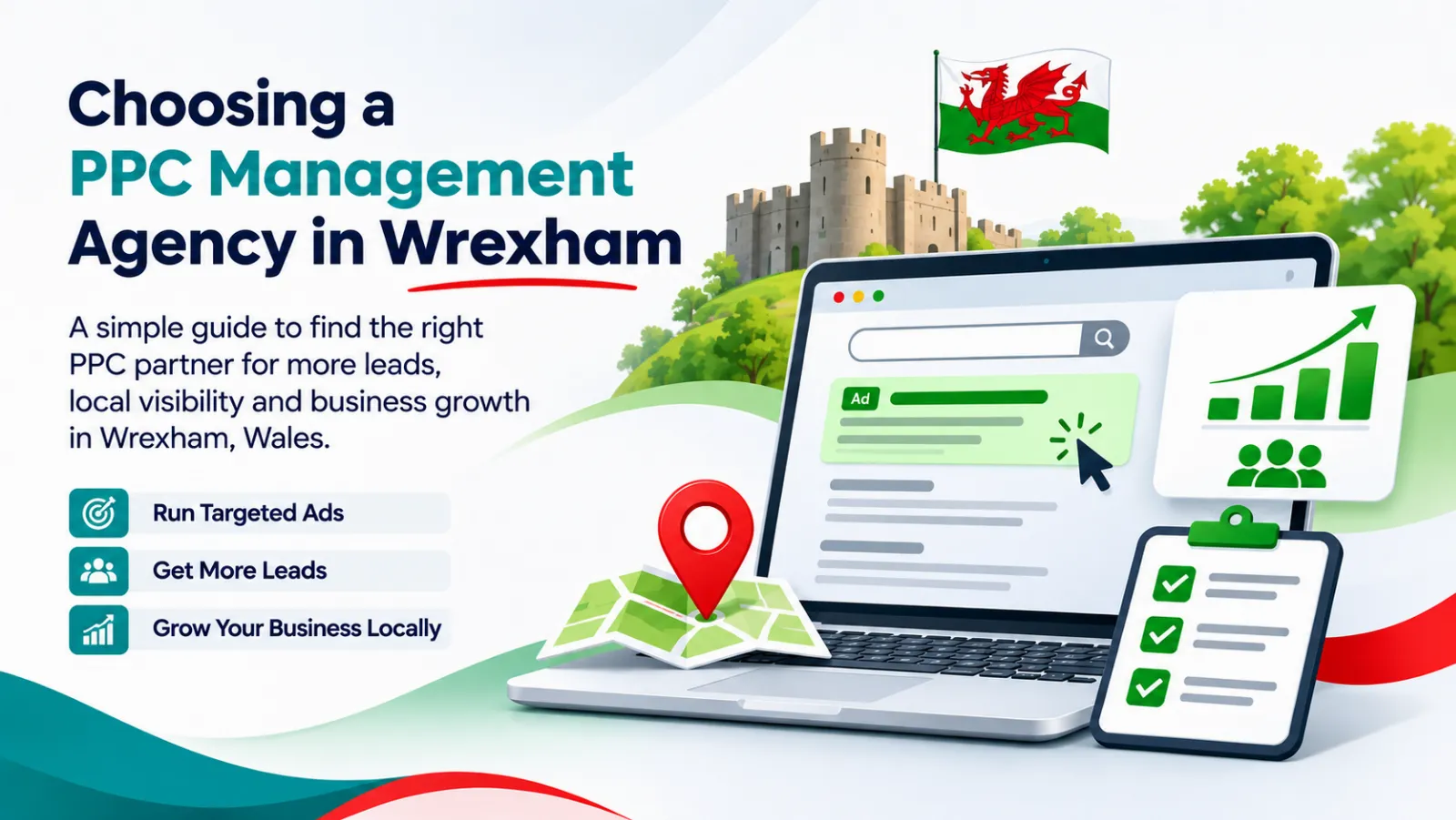
How to Choose the Best PPC Management Agency in Wrexham (2026)
How to choose a PPC management agency in Wrexham: what good management includes, Google vs Microsoft Ads, costs, proof to ask for and questions to ask.
PPC (pay-per-click) advertising lets you pay for that spot. But paying for it and getting value from it are two very different things. Plenty of local businesses spend a few hundred pounds a month on Google Ads, get clicks from the wrong people, and decide that PPC "doesn't work". Usually the problem was not PPC. It was how the account was set up and managed.
This guide is written to help you pick a PPC management agency in Wrexham (or one that works with Wrexham businesses) without getting burned. It covers what good management actually includes, how Google Ads and Microsoft Ads differ, how to think about cost, and the questions that separate a careful agency from a pushy one.
The short answer
The best PPC management agency for your business is the one that tracks real enquiries (not just clicks), explains its plan in plain English, lets you own your ad accounts, reports honestly every month, and does not promise results it cannot control. Ask for a small first scope or a short trial before signing a long contract, and judge the agency on cost per qualified enquiry, not on traffic.
What does a PPC management agency actually do?
Setting up an ad is the easy part. Anyone can do that in an afternoon. Management is the ongoing work that decides whether the money is well spent:
Keyword research: finding the searches that real customers use when they are ready to buy or enquire, and avoiding the ones that only bring browsers.
Campaign setup: structuring campaigns by service and location so each ad matches what the person searched for.
Ad writing and testing: trying different headlines and offers and keeping what works.
Negative keywords: blocking searches you do not want, such as "free", "jobs" or "DIY", so budget is not wasted.
Location settings: targeting Wrexham and the surrounding area properly, and checking that enquiries really come from where you work.
Conversion tracking: recording calls, form submissions and purchases, so you can see which clicks turned into business.
Landing page advice: telling you what to change on the page people land on, because a good ad sent to a weak page still loses money.
Regular reviews and reporting: checking search terms, budgets and results on a schedule, and explaining them to you.
Why PPC suits local businesses in Wrexham
People searching for "emergency plumber Wrexham" or "accountant for small business near me" usually want something done soon. That makes search advertising useful for local service businesses, because you appear at the moment someone is looking, not weeks before or after.
A few things make it practical for a smaller budget:
You choose the area. You can focus on Wrexham, nearby towns or a wider part of North Wales, and exclude places you do not serve.
You control the spend. You set a daily or monthly budget and change it as results come in. A budget does not guarantee a set number of clicks or leads, though.
You can measure the outcome. With proper tracking you can see how many calls and forms each campaign produced.
One caution: PPC is not magic. If your website is slow, confusing on mobile or has no clear way to get in touch, ads will only bring more people to a page that does not convert. A good agency will tell you this early.
Google Ads or Microsoft Ads?
Most local businesses start with Google Ads because that is where most searches happen. Microsoft Advertising (which covers Bing and its partner network) is smaller, but it can be worth testing once Google is working.
Google Ads | Microsoft Advertising | |
|---|---|---|
Search reach | The larger audience | A smaller audience |
Competition | Usually higher in popular trades and services | Often lower, which can mean fewer clicks but sometimes lower costs |
Local targeting | Yes | Yes |
Conversion tracking | Yes | Yes |
Good first step? | Yes, for most businesses | As a second channel once tracking is in place |
Costs, reach and results depend on your industry and your area, so do not trust anyone who says one platform is always cheaper. A sensible agency will start where your customers are, then test the other platform and compare the cost per enquiry.
Lead generation: clicks are not the goal
It is easy to buy clicks. It is much harder to buy enquiries from people who can and will pay you. The difference usually comes down to a few habits:
Bid on high-intent searches. "Commercial cleaning contract Wrexham" is more useful to a cleaning company than "how to clean a carpet".
Keep adding negative keywords. Reviewing the actual search terms each week and blocking the wasteful ones is one of the most valuable jobs in PPC.
Match the ad to the page. If the ad promises boiler repair, the page should be about boiler repair, not your homepage.
Keep the form short. Ask for what you need to reply, not a full questionnaire.
Look at lead quality, not only the number. Tell your agency which enquiries turned into jobs so the campaigns can improve.
Where AI fits into PPC today
Google and Microsoft both build automation into their ad platforms: automated bidding, ad combinations that test themselves, and suggestions inside the account. These tools can save time and often work well when the account has good tracking and enough data.
But they only optimise toward the goal you give them. If tracking counts every page view as a "conversion", the system will happily find you more page views. A person still needs to decide what a real lead is, check that the data is accurate, and say no to suggestions that do not suit your business. When an agency says it offers "AI-powered" PPC, ask what that means in practice and who checks the decisions.
How much does PPC management cost?
Two different costs get mixed up all the time:
Ad spend: what you pay Google or Microsoft for the clicks.
Management fee: what the agency charges to plan, run and improve the campaigns.
Agencies usually charge in one of these ways: a fixed monthly fee, a percentage of ad spend, a one-off project fee (for a set-up or an audit), or a mix. There is no standard price that fits every Wrexham business, because it depends on your industry, how competitive your keywords are and how much work the account needs. Always ask for the fee in writing and check what is included.
A simple way to decide how much you can afford to pay for an enquiry (the numbers below are made up, only to show the method):
An average job brings in £500.
About 1 in 4 enquiries becomes a paying customer.
So each enquiry is worth about £125 to you.
If your profit margin leaves room to spend up to about a third of that, your target is roughly £40 per enquiry.
Use your own numbers. Once you know your target cost per enquiry, you can judge any agency's results against something real.
What good proof looks like
People often ask for an agency with "strong local testimonials". Testimonials help, but they are easy to fake or cherry-pick, so look a little deeper:
Specific results: a case study that names the starting point, what was changed and what happened to enquiries or cost per lead.
Verifiable reviews: reviews on Google or other public platforms you can click through to.
A conversation with a current client: ask if you can speak to one for ten minutes.
Honesty about limits: an agency that tells you what it cannot promise is often more trustworthy than one that promises everything.
Be careful with reviews or numbers that cannot be checked, and with "best" or "number one" claims that do not say what they are based on.
10 things to look for in a PPC agency
Experience with businesses like yours, or at least a clear plan for learning your market.
Local targeting skill, including how they check that leads come from your service area.
Platform knowledge, especially Google Ads, plus Microsoft Ads if relevant.
A lead-generation plan, not just a traffic plan.
Proper conversion tracking, set up before the ads go live.
Landing page input, because the page decides how many clicks become enquiries.
Plain-English reports, showing spend, results, problems and next steps.
Realistic promises. Nobody can guarantee a number of leads.
Clear pricing and account ownership. Your ad accounts should be in your name.
Easy communication. You should be able to ask questions and get straight answers.
Questions to ask before you hire
Have you worked with businesses like mine, and what happened?
How will you target Wrexham and the nearby areas, and how will you stop wasted clicks from elsewhere?
Which platforms do you recommend for me, and why?
How will you track calls and forms, and what counts as a lead?
What is included in your fee, and what costs extra?
Will the ad accounts and data be in my name?
How often will I get reports, and who will explain them?
What will you do if the campaign is not working after the first month?
Can you suggest improvements to my landing page?
What should we realistically expect to measure in the first three months?
Mistakes local businesses make with PPC
Targeting too wide. Paying for clicks from people who will never become customers.
Skipping negative keywords. Without them, the budget leaks into irrelevant searches.
Sending everyone to the homepage. A dedicated page for each service usually works better.
Watching only clicks. Clicks feel good, but enquiries and sales pay the bills.
Changing things too fast. Campaigns need enough data before you judge them.
Trusting automation blindly. Review the suggestions against your real goals.
Can you run PPC yourself?
You can, and for simple campaigns with a small budget it is a reasonable way to learn. The catch is time: PPC needs regular checking of search terms, tracking and results. An agency becomes worth considering when you are spending money without getting useful enquiries, when tracking is unreliable, when you want to use more than one platform, or when you simply do not have the hours to look after it.
Working with GlanceTechy
GlanceTechy is a web design, development and digital marketing agency that works with businesses in the UK and other markets, including Wrexham. We look at PPC alongside the rest of the picture: the website, the landing pages, the tracking and the enquiry process, because ads only work as well as the page they send people to.
If you want an honest second opinion on your current ads or your website, we are happy to take a look. See our Wrexham page or get in touch for a free audit.
Final thoughts
Choosing a PPC agency is mostly about trust and clarity. Pick the team that understands your customers, tracks the right results, shows you what it is doing and tells you the truth when something is not working. Start small, measure cost per enquiry, and let the numbers decide whether to spend more.
Avoid anyone who promises instant sales, guaranteed rankings or fixed lead numbers. Real PPC results come from careful setup, steady testing and honest reporting.
Frequently asked questions
No agency can honestly claim to be the most effective for every business. Look for one that tracks real enquiries, reports clearly, lets you own your ad accounts and can show specific results, then compare two or three before choosing.
Ask for case studies that name the starting point and results, check reviews you can click through to on public platforms and ask to speak to a current client for a few minutes.
The best fit is an agency that measures cost per qualified enquiry, not clicks, and that works well with small budgets. Ask how they track calls and forms and how they reduce wasted spend.
It can be a useful second channel once Google Ads is working. The audience is smaller, but competition is often lower. Test it and compare the cost per enquiry on both platforms.
Ad platforms offer automated bidding, ad testing and suggestions. These work best with accurate tracking and human oversight, so ask who checks the automated decisions on your account.
There is no single price. Costs depend on your industry, competition and the work involved. Agencies charge a fixed monthly fee, a percentage of ad spend, a project fee or a mix. Ad spend is paid separately to Google or Microsoft.
Yes. PPC is managed online, so what matters is how well the agency understands your market, targets your area and reports results. Ask about local targeting and how they check lead locations.