WordPress vs Custom Website Development: Which Is Better?
Compare WordPress vs custom website development to discover the differences in cost, flexibility, scalability, SEO, and functionality. Learn which website development approach is best for your business, startup, or growing company.
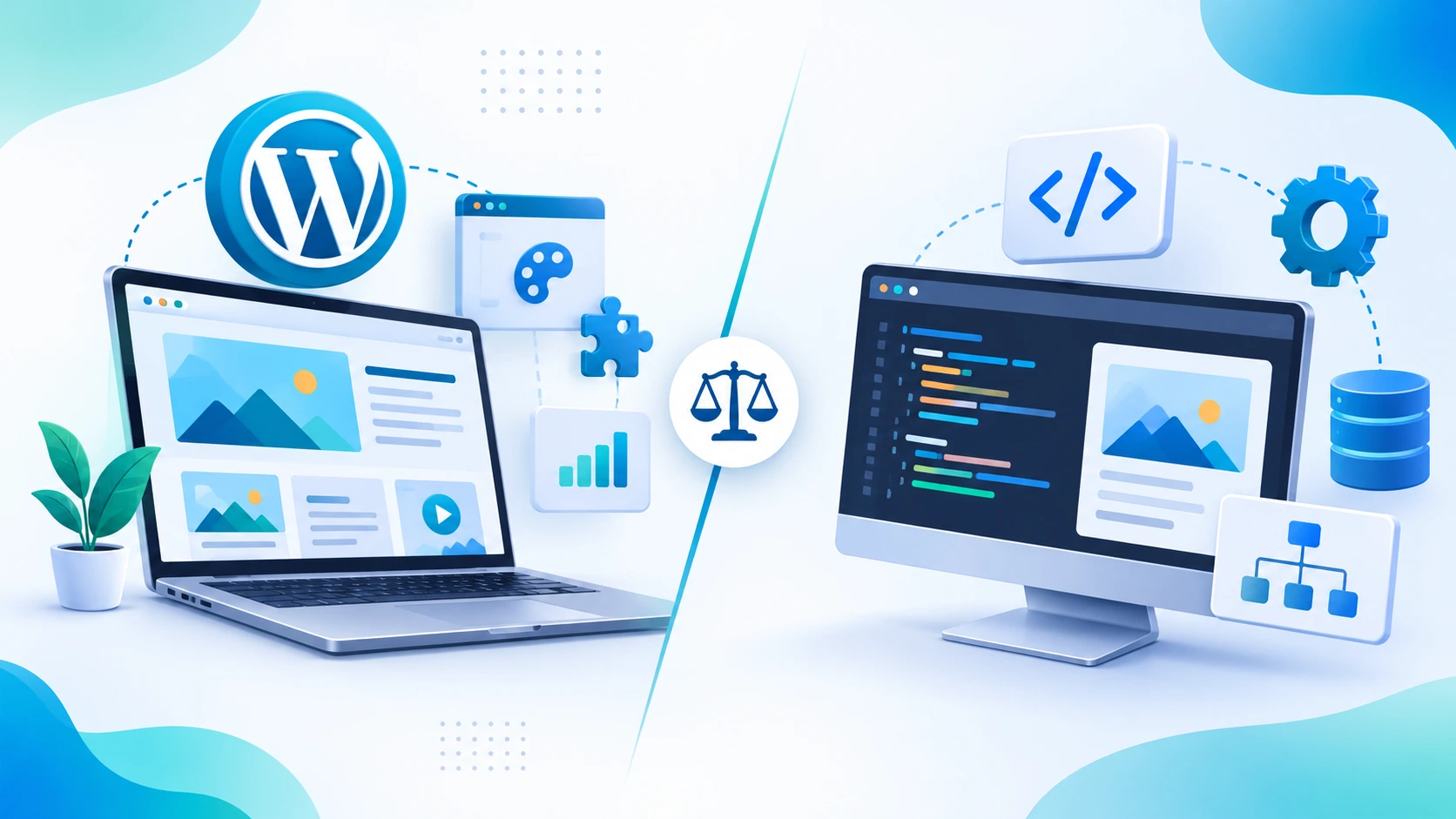
Two popular options are WordPress website development and custom website development. Both can help you build a professional online presence, but they offer different advantages in terms of flexibility, customization, development time, maintenance, and long-term scalability.
So, which option is better for your business?
The answer depends on your goals, budget, required features, and plans for future growth. In this guide, we'll compare WordPress vs custom website development to help you make an informed decision.
What Is WordPress Website Development?
WordPress is an open-source content management system (CMS) that allows businesses to create and manage websites without building every feature from scratch.
It provides themes, plugins, and built-in content management tools that make website creation more accessible. Businesses can use WordPress to build company websites, blogs, portfolios, online stores, and many other types of websites.
One of the biggest advantages of WordPress is its flexibility. You can start with an existing theme, customize the design, add plugins, or work with developers to create custom functionality.
Key Benefits of WordPress Development
1. Easy Content Management
WordPress makes it easier to create, edit, and publish website content. Business owners and marketing teams can update pages, publish blog posts, and manage media without depending on a developer for every small change.
2. Flexible Design Options
You can choose from different themes and customize layouts, colors, typography, and page structures to match your brand identity.
3. Extensive Plugin Ecosystem
WordPress offers thousands of plugins that can extend website functionality. You can add contact forms, SEO features, analytics, e-commerce capabilities, and other useful tools.
4. SEO-Friendly Capabilities
WordPress provides a flexible foundation for SEO. With proper website structure, optimized content, technical configuration, and performance improvements, businesses can build websites that support organic search visibility.
5. Easier Website Management
With the right hosting, maintenance, and security practices, WordPress websites can be managed and updated without requiring extensive technical knowledge.
What Is Custom Website Development?
Custom website development involves building a website specifically around your business requirements, design preferences, and functionality needs.
Unlike a standard theme-based setup, custom development gives developers greater control over how the website looks, works, and handles information.
Depending on the project, developers may use technologies such as HTML, CSS, JavaScript, PHP, Python, or modern frameworks like React and other development tools.
Custom websites are often suitable for businesses that need specialized features, complex integrations, advanced user experiences, or workflows that standard platforms cannot efficiently support.
Key Benefits of Custom Website Development
1. Complete Design Flexibility
A custom website can be designed around your brand, audience, and business requirements. You are not restricted to the structure or limitations of a pre-built theme.
2. Tailored Functionality
You can build specific features such as customer dashboards, booking systems, membership platforms, interactive tools, and business management systems.
3. Greater Control Over Architecture
Developers can select the technologies, frameworks, database structure, and integrations that best fit the project.
4. Integration With Business Systems
Custom development can support specialized integrations with CRM platforms, payment systems, inventory software, APIs, and internal business applications.
5. Room for Complex Requirements
For businesses with unique operational needs, custom development provides the flexibility to create solutions around existing workflows rather than changing the business process to fit a standard platform.
WordPress vs Custom Website Development: Key Differences
Both options can deliver professional websites, but they differ in how they are developed, managed, and expanded.
Here's a quick comparison:
Comparison Factor | WordPress Development | Custom Website Development |
Development approach | CMS-based development | Built around project requirements |
Initial development time | Often shorter | Usually longer |
Development cost | Often more affordable | Can require a larger investment |
Design flexibility | High with customization | Very high |
Content management | Built-in CMS | Depends on the solution developed |
Functionality | Themes, plugins, custom code | Custom-built features and integrations |
SEO capabilities | Strong with proper configuration | Strong with proper implementation |
Scalability | Suitable for many growing businesses | Can be designed for complex requirements |
Maintenance | Core, theme and plugin updates | Depends on the technology and architecture |
Technical expertise | Basic management is accessible | Often requires developer support |
Important: These differences are not absolute. A professionally developed WordPress website can include extensive custom coding, while a custom-developed website can also include an easy-to-use content management system.
WordPress vs Custom Website Development: Which Is More Affordable?
Budget is one of the most important factors when choosing a website development approach.
WordPress is often more affordable for businesses because developers can use existing themes, plugins, and content management features instead of creating everything from scratch.
Custom website development generally requires more planning, design, programming, testing, and specialized development work. As a result, the initial investment can be higher.
However, the total cost depends on the website's complexity, functionality, integrations, design requirements, hosting, and ongoing maintenance.
WordPress Development Costs
WordPress can be a practical option for businesses that need:
Professional business websites.
Company portfolios and service websites.
Blogs and content publishing platforms.
Small and medium-sized online stores.
Lead generation and landing pages.
Custom Website Development Costs
Custom development may be a better investment when your project requires:
Complex web applications.
Custom customer dashboards.
Advanced booking or subscription systems.
Specialized business workflows.
Multiple third-party integrations.
Unique functionality that standard plugins cannot provide.
Rather than choosing an option based only on its initial price, consider the total cost of ownership and the value the website can deliver over time.
Which Option Is Better for SEO?
Both WordPress and custom websites can perform well in search engines. Neither platform automatically guarantees better Google rankings.
SEO performance depends on how a website is planned, developed, and maintained.
Important factors include:
Website loading speed and performance.
Mobile-friendly design.
Proper URL structure.
Search engine crawlability and indexability.
Optimized page titles and meta descriptions.
Logical heading structure.
Internal linking.
Quality content.
Structured data where appropriate.
Technical SEO implementation.
WordPress offers themes and plugins that help manage several SEO-related tasks. Custom development gives developers more control over technical implementation, but SEO features must be planned and built correctly.
Our recommendation: Choose the platform that allows your business to maintain a fast, accessible, technically sound website with useful content and a good user experience.
WordPress vs Custom Development: Which Is Better for Different Businesses?
The best choice depends on the type of business and what you expect your website to accomplish.
1. Small Businesses and Startups
For most small businesses and startups, WordPress is a practical starting point.
It allows businesses to establish an online presence, showcase services, publish content, and generate customer enquiries without investing heavily in complex development.
2. E-commerce Businesses
WordPress with WooCommerce can be a good choice for many online stores, especially when businesses need product listings, shopping carts, payment options, and store management features.
However, businesses with specialized shopping experiences, complex inventory systems, or unique checkout requirements may benefit from custom development.
3. Growing and Established Companies
Growing companies can use either approach.
WordPress is suitable when the business needs a manageable website with regular content updates and standard business functionality.
Custom development becomes more attractive when the company requires advanced integrations, specialized workflows, or application-like functionality.
4. SaaS Companies and Web Applications
For SaaS platforms and complex web applications, custom development is often more appropriate.
These projects may require user authentication, subscription management, dashboards, data processing, and specialized application features.
WordPress can still support certain membership and subscription-based projects, but the right architecture depends on the product's requirements.
Can You Combine WordPress and Custom Website Development?
Yes. In fact, combining both approaches can be an excellent solution.
A business does not always have to choose between a completely standard WordPress website and a fully custom-built platform.
WordPress can provide the content management foundation, while developers create custom themes, plugins, integrations, and functionality.
For example, a business website might use WordPress to manage service pages and blog content while incorporating:
Custom-designed website layouts.
AI-powered chatbots.
CRM integration.
Automated enquiry management.
Custom booking functionality.
Advanced lead generation forms.
Third-party API integrations.
This approach gives businesses the convenience of WordPress with additional flexibility where needed.
7 Important Factors to Consider Before Choosing
Before deciding between WordPress and custom website development, consider these questions:
1. What Is Your Website's Main Purpose?
Are you building a company website, an online store, a portfolio, or a web application? Your website's purpose should guide your technology choice.
2. What Is Your Budget?
Consider the initial development cost as well as hosting, updates, security, maintenance, and future improvements.
3. How Much Custom Functionality Do You Need?
If your website requires standard business features, WordPress may be sufficient. Complex requirements may justify custom development.
4. Who Will Manage the Website?
If your team regularly publishes blogs, updates service pages, and changes website content, a content management system can make everyday management easier.
5. What Are Your Future Growth Plans?
Think about how your website may need to evolve over the next few years. Choose an approach that can accommodate realistic future requirements.
6. What Integrations Do You Need?
Consider whether your website needs to connect with payment gateways, CRM systems, marketing platforms, inventory tools, or other business software.
7. How Important Are Performance and Security?
Both approaches require proper development practices, secure configurations, regular maintenance, and performance monitoring.
WordPress vs Custom Website Development: Our Final Verdict
So, which is better: WordPress or custom website development?
There is no single answer that works for every business.
WordPress is an excellent choice for companies that need a professional, manageable, and flexible website without building everything from the ground up. It works particularly well for small businesses, startups, service providers, blogs, and many e-commerce websites.
Custom website development is more suitable when a project requires specialized functionality, complex integrations, unique user experiences, or a tailored application architecture.
The smartest approach is to evaluate your business goals, technical requirements, budget, and long-term plans before making a decision.
A well-developed website should do more than look attractive. It should provide a smooth user experience, communicate your brand effectively, support your marketing strategy, and help turn visitors into customers.
Need Help Choosing the Right Website Development Approach?
At GlanceTechy, we help businesses build modern, responsive, and performance-focused websites that support their business goals.
Whether you need a WordPress website, a custom website, an e-commerce platform, or advanced website functionality with AI integration, our team can help you find an approach that fits your requirements.
We focus on thoughtful design, reliable development, user experience, and SEO-ready website structures to help businesses build a stronger digital presence.
Ready to build your next website?
Contact GlanceTechy to discuss your project and get a free quote.
Frequently asked questions
WordPress is often better for businesses that need an affordable, manageable website with standard features. Custom development is more suitable for projects requiring specialized functionality, complex integrations, or unique application features.
Custom websites often require a higher initial investment because they involve more planning, design, and programming. However, the actual cost depends on the project's complexity and requirements.
Yes. WordPress is suitable for many business websites, including company websites, service websites, blogs, portfolios, and online stores. It offers flexible design and content management capabilities.
Both can perform well in search engines. Website speed, mobile usability, technical SEO, content quality, site structure, and user experience matter more than the platform alone.
Yes. Developers can customize WordPress themes, create custom plugins, add business-specific features, and integrate external services to meet different requirements.
Yes. A business can migrate from WordPress to a custom-developed website. The process requires careful planning to preserve important content, URLs, SEO signals, and functionality.
Look for a company with relevant project experience, transparent communication, a clear development process, technical expertise, and ongoing support. Make sure the company understands your business goals before recommending a technology.